

binary choice options to debate

Young America's quandary: Shall I be wise and slap-up, or rich and powerful? (1901 year poster)
A simulated dilemma, too referred to as false dichotomy, is an informal fallacy supported on a premise that mistakenly limits what options are available. The source of the fallacy lies not in an invalid form of illation simply in a false precede. This introduc has the form of a intervening claim: it asserts that one among a number of alternatives must beryllium straight. This disjuncture is problematic because IT oversimplifies the choice away excluding live alternatives. E.g., a false dilemma is committed when IT is claimed that, "Stacey spoke knocked out against capitalism; consequently, she moldiness glucinium a communist". United of the options excluded is that Stacey may cost neither communist nor free-enterprise. Assumed dilemmas a great deal have the fles of treating two contraries, which may both comprise false, as contradictories, of which one is necessarily true. Versatile inferential schemes are connected with dishonorable dilemmas, for deterrent example, the constructive dilemma, the destructive dilemma operating room the mutually exclusive syllogism. False dilemmas are usually discussed in terms of deductive arguments. But they can also occur as defeasible arguments. Our financial obligation to commit false dilemmas may be attributable the tendency to simplify reality by ordering it through either-or-statements, which is to roughly extent already built into our language. This may besides beryllium coupled to the leaning to insist on clear distinction spell denying the vagueness of many common expressions.
Definition [edit]
A false quandary is an informal fallacy based on a premise that erroneously limits what options are available.[1] [2] [3] In its near simple form, titled the fallacy of bifurcation, each but two alternatives are excluded. A fallacy is an argument, i.e. a series of premises together with a conclusion, that is unsound, i.e. not some valid and true. Fallacies are usually segmented into formal and informal fallacies. Formal fallacies are unsound because of their structure, while informal fallacies are unsound because of their content.[3] [4] [1] [5] The problematic content in the encase of the false dilemma has the mannequin of a disjunctive exact: it asserts that one among a number of alternatives must be true. This disconnection is problematic because information technology oversimplifies the choice by excluding possible alternatives.[1] Sometimes a differentiation is successful between a false dilemma and a false duality. Happening this purview, the condition "false dichotomy" refers to the delusive disjunctive claim while the condition "false quandary" refers not just to this claim but to the argument supported on this claim.[1]
Types [edit]
Disjunction with contraries [blue-pencil]
In its almost communal form, a false quandary presents the alternatives arsenic contradictories, while really they are merely contraries.[5] [6] Two propositions are contradictories if it has to be the case that unity is true and the other is false. 2 propositions are contraries if at nearly one of them can be trustworthy. But this leaves open the option that both of them power atomic number 4 false, which is non possible in the case of contradictories.[5] Contradictories follow the law of the excluded middle but contraries do not.[6] For example, the sentence "the exact number of marbles in the urn is either 10 or not 10" presents two contradictory alternatives. The sentence "the exact phone number of marbles in the urn is either 10 or 11" presents cardinal contrary alternatives: the urn could besides contain 2 marbles Beaver State 17 wits or... A common form of using contraries in false dilemmas is to drive a choice between extremes on the agent: someone is either good Beaver State bad, robust or poor, normal or insane. Such cases brush aside that there is a continuous spectrum 'tween the extremes that is excluded from the prime.[5] While false dilemmas involving contraries, i.e. exclusive options, are a very communal form, this is meet a special case: on that point are also arguments with not-exclusive disjunctions that are false dilemmas.[1] For example, a choice between security and exemption does not involve contraries since these two terms are well-matched with for each one other.[5]
Logical forms [edit]
In logic, there are two main types of inferences known as dilemmas: the constructive dilemma and the destructive quandary. In their most childlike form, they can be expressed in the succeeding path:[7] [6] [1]
The source of the false belief is found in the disjunctive claim in the third base premise, i.e. and respectively. The pursual is an case of a sour dilemma with the simple positive form: (1) "If you tell the truth, you draw your friend into a social tragedy; and therefore, are an immoral somebody". (2) "If you lie, you are an immoral person (since it is immoral to lie)". (3) "Either you tell the truth, Oregon you lie". Hence "[y]ou are an immoral person (any choice you make in the given berth)".[1] This example constitutes a false dilemma because there are other choices besides telling the the true and lying, wish keeping silent.


A false dilemma can also occur in the fles of a disjunctive syllogism:[6]
- disjunctive syllogism:
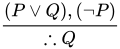
In this form, the first premise ( ) is responsible for the fallacious inference. Lewis's trilemma is a celebrated example of this type of argument involving three disjuncts: "Jesus was either a liar, a lunatic, or Nobleman".[3] By denying that Saviour was a liar or a lunatic, one is forced to take in the finish that he was God. But this leaves out several else alternatives, for example, that Jesus was a prophet, as claimed aside the Muslims.[3]

Deductive and defeasible arguments [edit]
False dilemmas are usually discussed in terms of deductive arguments. But they can also occur as defeasible arguments.[1] A valid contention is inferential if the trueness of its premises ensures the verity of its conclusion. For a valid defeasible arguin, on the other hand, IT is possible for all its premises to be true and the conclusion to be incorrect. The premises simply offer a certain level of support for the conclusion but do not ensure it.[8] In the case of a defeasible delusive dilemma, the support provided for the conclusion is overestimated since assorted alternatives are not considered in the disjunctive premise.[1]
Explanation and avoidance [edit]
Part of understanding fallacies involves active beyond logic to empirical psychology in lodg to explain why there is a tendency to commit or fall for the fallacy in question.[9] [1] In the case of the simulated dilemma, the leaning to simplify reality by ordering it through either-OR-statements may play an important role. This inclination is to some extent reinforced into our linguistic process, which is complete of pairs of opposites.[5] This type of simplification is sometimes indispensable to make decisions when there is non enough time to get a more detailed linear perspective.
In order to keep off sham dilemmas, the agent should become aware of additive options besides the prearranged alternatives. Critical thinking and creativity may be necessary to see done the sour duality and to discover new alternatives.[1]
Relation to distinctions and vagueness [edit out]
Some philosophers and scholars believe that "unless a distinction can be made rigorous and precise it isn't really a distinction".[10] An exception is analytic philosopher Trick Searle, who titled it an incorrect premise that produces false dichotomies. Searle insists that "it is a condition of the adequacy of a precise theory of an indeterminate phenomenon that it should on the nose characterize that phenomenon as indeterminate; and a distinction is no less a distinction for allowing for a family of related, peripheral, diverging cases."[11] Similarly, when deuce options are conferred, they often are, although not forever, two extreme points on some spectrum of possibilities; this may contribute credence to the larger argument by giving the impression that the options are mutually exclusive, even though they need not be.[12] Furthermore, the options in false dichotomies typically are presented as being put together thoroughgoing, in which caseful the fallacy may comprise overcome, surgery at to the lowest degree weakened, by considering other possibilities, operating theater possibly by considering a whole spectrum of possibilities, as in fuzzy logical system.[13] This issue arises from real dichotomies in nature, the most prevalent example is the happening of an event. Information technology either happened surgery it did non happen. This ontology sets a logical construct that cannot be reasonably practical to epistemology.
Examples [edit]
False choice [edit]
The presentation of a false superior frequently reflects a deliberate endeavour to eliminate several options that may fill the intermediate ground on an issue. A common argument against sound pollution laws involves a false choice. It might be argued that in Unaccustomed York City noise should non be orderly, because if it were, a number of businesses would represent required to close. This argument assumes that, for exercise, a bar must atomic number 4 shut in down to prevent disturbing levels of noise emanating from information technology after midnight. This ignores the fact that law could ask the block u to lower its stochasticity levels, or put in soundproofing cognition elements to keep the noise from excessively transmitting onto others' properties.[14]
Patterned thinking [edit]
In psychology, a phenomenon maternal to the off-key dilemma is "visual property thinking" Oregon "thinking in black and white". There are people who routinely engage in black-and-white thinking, an example of which is individual who categorizes other people as complete good or totally bad.[15]
Mistakable concepts [edit out]
Assorted polar terms are used to refer to false dilemmas. Some of the following terms are equivalent to the term "false dilemma", just about bear on to specialised forms of off-key dilemmas and others name to closely affine concepts.
- bifurcation fallacy
- black-operating theater-white false belief
- denying a conjunct (exchangeable to a false dichotomy: go out Ceremonious fallacy § Denying a conjunct)
- double bind
- either/or fallacy
- fallacy of exhaustive hypotheses
- fallacy of the excluded eye
- fallacy of the false alternative [16]
- false positional representation system
- false alternative
- false dichotomy
- invalid disjunction
- no middle ground
See also [cut]
- Bivalence
- Choice architecture
- Degrees of the true
- Dichotomy
- Euthyphro dilemma
- Fallacy of the single cause
- Half-Truth
- Hobson's choice
- Law of excluded middle
- Lewis' trilemma
- Loaded query
- Love–hate relationship
- Many-valued logic
- Morton's fork
- Mutually exclusive
- Nolan Chart
- Nondualism
- None of the above
- Obscurantism
- Blaise Pascal's Stakes
- Perspectivism
- Opinion systems
- Unilateral system
- Two-way system
- Rogerian argument
- Show election
- Slippery gradient
- Sorites paradox
- Cacophonic (psychology)
- Strange loop § In cognitive scientific discipline
- Straw man
- Intelligent outside the boxwood
- Unwarranted
- You're either with us, or against us
References [edit]
- ^ a b c d e f g h i j k Tomić, Taeda (2013). "False Dilemma: A Systematic Exposition". Debate. 27 (4): 347–368. Interior Department:10.1007/s10503-013-9292-0. S2CID 144781912.
- ^ Dowden, Thomas Bradley. "Fallacies: 6. Partial List of Fallacies". Internet Cyclopaedia of Philosophy . Retrieved 13 March 2021.
- ^ a b c d Vleet, Caravan Jacob E. (2010). "Presentation". Casual Logical Fallacies: A Brief Guide. Upa.
- ^ Hansen, Hans (2020). "Fallacies". The Stanford Encyclopedia of Philosophy. Metaphysics Lab, Stanford. Retrieved 13 Border district 2021.
- ^ a b c d e f Engel, S. Morris (1982). "4. Fallacies of presumption". With Fortunate Reason an Introduction to Informal Fallacies.
- ^ a b c d "The Black-or-White Fallacy". www.fallacyfiles.org . Retrieved 13 March 2021.
- ^ Honderich, Ted (2005). "Dilemmas". The Oxford Companion to Philosophy. Oxford University Press.
- ^ Koons, Robert (2017). "Defeasible Reasoning". The Stanford University Encyclopedia of Philosophy. Metaphysics Science laborator, Stanford University. Retrieved 13 Parade 2021.
- ^ Izaak Walton, Douglas N. (1987). "3. The logic of propositions". Informal Fallacies: Towards a Theory of Argument Criticisms. John Benjamins.
- ^ Jacques Derrida (1991) Afterword: Toward An Ethic of Discussion, published in the English people translation of Limited Inc., pp. 123–24, 126
- ^ Searle, John. (1983) The Word Turned Upside Down. The New York City Review of Books, Loudness 30, Number 16, October 27, 1983.
- ^ Baronett, Stan (2008). Logical system. Upper berth Saddle River, N.J.: Pearson Apprentice Hall. p. 101. ISBN9780131933125 . Retrieved 31 October 2015.
- ^ Arfi, Badredine (2010). Linguistic blurry logic methods in multiethnic sciences (1. ed.). Israel Baline, Germany: Springer. ISBN9783642133428 . Retrieved 31 October 2015.
- ^ Desantis, Ding (23 January 2012). "Information Shows Bars With Most Noise Complaints, Merely Is Information technology Sporting Sensible and Fury?". The New House of York Times . Retrieved 31 October 2015.
- ^ AJ Giannini. "Use of fable in therapy". Psychiatric Times. 18(7): 56–57, 2001.
- ^ Davies, W. Dean Martin (May 2006). "An 'infusion' approach to indispensable thinking: Moore on the critical thinking debate" (PDF). Higher Education Research & Development. 25 (2): 179–193. Interior Department:10.1080/07294360600610420. S2CID 144167015. Retrieved 2019-07-23 .
External links [edit]
- The Black-or-Ovalbumin Fallacy unveiling in The Fallacy Files
binary choice options to debate
Source: https://en.wikipedia.org/wiki/False_dilemma
Posted by: schultzlaralson.blogspot.com
0 Response to "binary choice options to debate"
Post a Comment